This article was sourced from The House of Yahweh. You can
navigate the article from the menu links on the left which are designed to allow the reader to skip to particular facts
documented in this article. The House of Yahweh led by Yisrayl Hawkins is the
leading authority on the great Name of Yahweh our Heavenly Father, and has been
main organization responsible for restoring its use in these last days. To
read the entire article on one page click on
The Name
of Yahweh
The Prohibition Of Yahweh's Name
Authoritative scholars, such as the one shown above, point out that the
original, personal name of our Creator, written
 in the Hebrew tongue spoken by
all the patriarchs and prophets, is correctly written and pronounced Yahweh in
English.
in the Hebrew tongue spoken by
all the patriarchs and prophets, is correctly written and pronounced Yahweh in
English.
In ancient times, the Hebrew words were written without vowels in what is called
the unpointed script, so that each word consisted of a group of consonants whose
vowel sounds were supplied from memory by the reader. In other words, Hebrew
words were pronounced with vowel sounds even though the vowels themselves were
not written. The Hebrews knew, from oral teaching and practice, which vowels
were associated with the different words. Yahweh's Name is written
yod-heh-waw-heh
in Hebrew, transliterated YHWH in English, but is written and
pronounced with the proper vowels YAHWEH as these sources show. Notice what
The
Jewish Encyclopedia of 1901, Volume 12, page 119, states.
It thus becomes
possible to determine with a fair degree of certainty the
historical pronunciation of the Tetragrammaton, the results agreeing with the
statement of Ex. iii. 14, in which YHWH terms Himself
 . "I will be", a phrase
which is immediately proceeded by the fuller term "I will be that I will be,"
or, as in the English versions, "I am" and "I am that I am." The name
is
accordingly derived from the root
. "I will be", a phrase
which is immediately proceeded by the fuller term "I will be that I will be,"
or, as in the English versions, "I am" and "I am that I am." The name
is
accordingly derived from the root
 (=), and is regarded as an imperfect.
This
passage is decisive for the pronunciation "Yahweh"; for the etymology was
undoubtedly based on the known word.
(=), and is regarded as an imperfect.
This
passage is decisive for the pronunciation "Yahweh"; for the etymology was
undoubtedly based on the known word.
The Encyclopedia Judaica, Volume 7, page 680, further states this fact.
The true pronunciation of the name YHWH was never lost. Several early Greek
writers of the Christian Church testify that the name was pronounced "Yahweh".
This is confirmed, at least for the vowel of the first syllable of the name, by
the shorter form Yah, which is sometimes used in poetry (e.g., Ex. 15:2) and the
-yahu or -yah that serves as the final syllable in very many Hebrew names.
The Encyclopedia Britanica, Volume 23, page 867, confirms this fact.
YAHWEH, the
proper name of the God of Israel; it is composed of four consonants
(YHWH) in Hebrew and is therefore called the Tetragrammaton...
The Universal Jewish Encyclopedia, Volume 9, page 160, confirms this fact.
Of the names of God in the Old Testament, that which occurs most frequently
(6,823 times) is the so-called Tetragrammaton, YHWH (),
the distinctive personal
name of the God of Israel.
And The Jewish Encyclopedia Volume 12, pages 118-119, confirms this fact also.
TETRAGRAMMATON: The quadriliteral name of God, ().
The Tetragrammaton is the
ancient Israelitish name for God...
The Jewish Encyclopedia, Volume 9, pages 162-163, also shows us that while the
rabbis recognized only one proper name for the Creator, they also considered
other names as titles for the Creator. As you read this excerpt, notice and
remember the title (Adonai) that was used in place of the Creator's Name:
...The Rabbis as well as the cabalists steadfastly maintained their belief in
monotheism. Hence they recognized only one proper name for the Deity,
considering the other names as appellations or titles signifying divinity,
perfection, and power, or as characterizing His acts as observed and appreciated
by mankind...The name YHWH is considered as the Name proper; it was known in the
earliest rabbinical works simply as the Name; also as Shem ha-Meyuhad ("the
Extraordinary Name"; Sifre, Num. 143): as Shem ha-Meforash ("the Distinguished
Name"; Yoma vi. 2); as Shem ben The Name. Arba' Otiyyot ("the Tetra-grammaton"
or "the Quadrilateral Name"; Kid 71a); and as Yod He Waw He (spelling letters of
YHWH).
It is recorded that the pronunciation of the Name Yahweh began to be suppressed
in earnest upon the death of a man named Simeon the Just, a High Priest who
served in this office in the time span of 310-199 B.C.E., or about 200 years
before the nation of Israyl came under the rulership of the Roman Empire. The
Jewish Encyclopedia of 1901, Volume 11, page 353, points out that this was the
turning point, namely the exact time when it became a practice in Israyl to no
longer pronounce the Name Yahweh.
SIMEON THE JUST ( ): High priest. He is identical either with Simeon I. (310-291
or 300-271 b.c.), son of Onias I., and grandson of Jaddua, or with Simeon II.
(219-199 b.c.), son of Onias II... After Simeon's death men ceased to utter the tetragrammaton aloud (Yoma 30b; Tosef Sotah. xiii.).
): High priest. He is identical either with Simeon I. (310-291
or 300-271 b.c.), son of Onias I., and grandson of Jaddua, or with Simeon II.
(219-199 b.c.), son of Onias II... After Simeon's death men ceased to utter the tetragrammaton aloud (Yoma 30b; Tosef Sotah. xiii.).
The Babylonian Talmud, Tractate Yoma, page 39b, also verifies that it was upon
the death of Simeon the Righteous, that all Israyl began to no longer pronounce
the Name Yahweh.
...When Simeon the Righteous died, with many indications that such glory was no
more enjoyed, his brethren no more dared utter the Ineffable Name...
The Jewish Encyclopedia Volume 9, pages 162-163, not only confirms this fact,
but it shows the strict prohibition and warning to all those who do not adhere
to it.
The restriction upon communicating the Name proper probably originated in
Oriental etiquette; in the East even a teacher was not called by name. For
naming his master Elisha, Gehazi was punished with leprosy (II Kings viii. 5;
Sanh. 100a). After the death of the high priest Simeon the Righteous, forty
years prior to the destruction of the Temple, the priests ceased to pronounce
the Name (Yoma 39b). From that time the pronunciation of the Name was
prohibited. "Whoever pronounces the Name forfeits his portion in the future
world" (Sanh. xi. 1). Hananiah ben Teradion was punished for teaching his
disciples the pronunciation of the Name (`Ab. Zarah 17b).
The Babylonian Talmud, Tractate Kiddushin, page 71a, openly admits, however,
that the Name Yahweh was pronounced by all the children of Israyl, both small
and great, before the death of Simeon the Just.
Our Rabbis taught: At first [Yahweh's] Name used to be entrusted to all people.
When unruly men increased, it was confided to the pious of the priesthood
Only The High Priest Spoke The Name Of Yahweh
Many teachers in Israyl came to believe that the Name Yahweh was too holy to be
pronounced, so they began teaching the nation that only the High Priest should
utter this Name, once a year on the Day of Atonement. The Century Bible, by
Adeney and Bennett, Volume 1, pages 90-91, shows us this information.
Some time after the return from the Captivity, and before the beginning of the
Christian era, the Jews came to believe that the Name YHWH was too sacred to be
uttered on ordinary occasions. It was said to be pronounced by the High Priest
on the Day of Atonement.
Please note the time period in which the Name of our Heavenly Father was
suppressed, some time after the return from the captivity, and before the
beginning of the Christian Era (approximately 310-199 B.C.E.). This means that
up to this time, the prophets, and in fact all the people of Israyl, used the
great Name of Yahweh when they walked through the waters of the Red Sea; when
they ate manna which came directly from Yahweh; when they saw their enemies
expelled from in front of them; when they took the lands from their enemies; and
all the while, they were becoming a healthy nation. It was only in turning from
Yahweh to idolatry, as we are doing today, that caused Yahweh to hide His face
from Israyl and give their enemies advantage over them.
The Jewish Encyclopedia contains additional information about the pronunciation
of Yahweh's Name being confined to the temple and spoken only by the priests.
Volume 9, pages 162-163, states: The pronunciation of the written Name was used
only by the priests (Num. vi. 22-27); outside the Temple they used the title "Adonai"
(Sotah vii. 6; p. 38a)...
Volume 1, pages 201-202, shows us this:
...In the early period of the Second Temple the Name was still in common use, as
may be learned from such proper names as Jehohanan, or from liturgical formulas,
such as Halelu-Yah. At the beginning of the Hellenistic era, however, the use of
the Name was reserved for the Temple. From Sifre to Num. vi. 27, Mishnah Tamid,
vii. 2, and Sotah, vii. 6 it appears that the priests were allowed to pronounce
the Name at the benediction only in the Temple; elsewhere they were obligated to
use the appellative name (kinnuy) "Adonai"' ...
...Pronunciation of the Name by the Temple priests... also gradually fell into
disuse. Tosef., Sotah, xiii. 8 quoted Menahot, 109b, and Yoma 39b, relates that
"from the time Simon the Just died [this is the traditional expression for the
beginning of the Hellenistic period], the priests refrained from blessing the
people with the Name"__in other words, they pronounced it indistinctly, or they
mouthed or mumbled it. Thus says Tosef., Ber. vi. 23: Formerly they used to
greet each other with the Ineffable Name; when the time of the decline of the
study of the Law came, the elders mumbled the Name. Subsequently also the solemn
utterance of the Name by the high priest on the Day of Atonement, that ought to
have been heard by the priests and the people according to the Mishnah Yoma, vi.
2, became inaudible or indistinct.
R. Tarfon (or Tryphon) relates (Yer. Yoma, iii. 40d): "I was standing in the row
of young priests, and I heard the high priest mumbling the Name, while the rest
of the priests were chanting."
...But while even among these the right pronunciation was forgotten in the
course of time, and the hope was expressed by Phinehas b. Jair, "the Saint",
that the knowledge and the correct use of the Name, so wondrously efficacious in
the blessed days long goneby, would again be restored in the Messianic age (see
Pes. 50a, Midr. Teh. to Ps. xxxvi. and to Ps. xci.)...
Volume 11, page 263, shows us more:
...the Mishnah (Sotah vii. 6; Tamid vii. 2) says, in conformity with this
interpretation: "In the Sanctuary the name of God [in the three blessings, Num.
vi. 24-26] is to be pronounced in the Priestly Benediction as it is written [];
but outside the Sanctuary it must be given the paraphrastic pronunciation []."
The high priest spoke the name of God on the Day of Atonement in his recitation
of Lev. xvi. 30 during the confessions of sins; and when the priests and the
people in the great hall heard him utter the "Shem ha-Meforash", they prostrated
themselves and glorified God, saying: "Praised by the glorious name of His
kingdom for ever and ever" (Yoma vi. 2). When a very young priest, the
well-known tanna Tarfon witnessed this ceremony; and he declares that the high
priest uttered the holy name of God so that his voice was merged in the song of
priests (Yer. Yoma 40d, below; Kid. 71a; Eccl. R. iii. 11), although it was
believed that when, at this point in the ritual, the priest pronounced the name
of God he was heard as far as Jericho (Tamid iii. 7; comp. Yoma 39b). Tarfon's
account, that the voice of the high priest was drowned by the song of other
priests, also confirms the synchronous statement (Yer. Yoma 40b) that in former
times the high priest uttered the Name with a loud voice, but that subsequently,
when immorality had become more and more prevalent, he lowered his voice lest
the Name should be heard by those unworthy to hear it...
The Shem ha-Meforash as an object of the esoteric knowledge of scholars appears
in the statement of Johanan (Kid. 71a): "Once each week the sages give their
pupils the Four-Lettered Name." A tannaitic passage in Yer. Yoma 40d, however,
says: "In former times the Name was taught to all; but when immorality increased
it was reserved for the pious," although this statement refers, according to the
baraita in Kid. 71a, to teaching the Name to the priests.
The Name of Yahweh Engraved on an Ivory Pomegranate Decoration
Biblical Archaeology Review. Jan.-Feb. 1990, page 49- "BAR recently
published a beautiful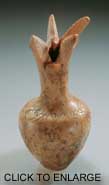 carved ivory pomegranate with an important inscription on it. As partially
reconstructed, the engraved inscription around the neck of the pomegranate reads
as follows: "Belonging to the House of Yahweh Holy to the Priests." Based on
this reading, many scholars have concluded that the ivory pomegranate originally
came from the Jerusalem Temple constructed by King Solomon."
carved ivory pomegranate with an important inscription on it. As partially
reconstructed, the engraved inscription around the neck of the pomegranate reads
as follows: "Belonging to the House of Yahweh Holy to the Priests." Based on
this reading, many scholars have concluded that the ivory pomegranate originally
came from the Jerusalem Temple constructed by King Solomon."
Immorality came among the people because Yahweh and His Laws were not being
taught or practiced. So without authority from the inspired words of the
prophets, our forefathers removed the name of Yahweh from the memory of our
people. Instead of teaching Yahweh's Laws, they turned to the traditions of the
Gods of earth and heaven!
Volume 9, page 163, further states:
It appears that a majority of the priests in the last days of the Temple were
unworthy to pronounce the Name, and a combination of the letters or of the
equivalents of the letters constituting the Name was employed by the priests in
the Temple. Thus the Twelve-Lettered Name was substituted, which, a baraita
says, was at first taught to every priest; but with the increase of the number
of licentious priests the Name was revealed only to the pious ones, who
"swallowed" its pronunciation while the other priests were chanting. Another
combination, the Forty-two-Lettered Name, Rab says, was taught only to whomever
was known to be of good character and disposition, temperate, and in the prime
of life (Kid. 71a; comp. Rashi to `Ab. Zarah 17b). Maimonides, in his "Moreh,''
thinks that these names were perhaps composed of several other divine names.
The Incommunicable Name was pronounced "Adonai", and where Adonai and yhwh occur
together the later was pronounced "Elohim".
Volume 12, page 119, states:
The avoidance of the original name of God both in speech and, to a certain
extent, in the Bible was due according to Geiger ("Urschrift," p. 262), to a
reverence which shrank from the utterance of the Sublime Name; and it may well
be that such a reluctance first arose in a foreign, and hence in an "unclean"
land, very possibly, therefore, in Babylonia. According to Dalman (l.c. pp. 66
et seq.), the Rabbis forbade the utterance of the Tetragrammaton, to guard
against desecration of the Sacred Name; but such an ordinance could not have
been effectual unless it had met with popular approval.
We have seen, from these well-known and accepted sources, the following facts:
a.Yahweh is the ancient, original, distinctive, personal, proper name of the
Creator;
b.The rabbis recognized yahweh as the proper Name for the Creator;
c. The rabbis considered names other than the true Name as names for the
Creator;
d.The pronunciation of Yahweh's Name began to be suppressed in the third century
B.C.E.; e.The Name of Yahweh was considered to be too holy to pronounce;
f.The pronunciation of the written Name was used only by the priests; and that,
g.Those who were not priests, and priests when outside the temple, used the
titles Adonai and Elohim when referring to the Creator.
The fact still remains that although the pronunciation of Yahweh's Name was
prohibited from being spoken (beginning around the third century b.c.e.), Yahweh
has not allowed the true pronunciation of His Name to be lost. And, the scholars
do admit this fact. Notice what The Jewish Encyclopedia of 1901, Volume 12, page
119, states:
It thus becomes possible to determine with a fair degree of certainty the
historical pronunciation of the Tetragrammaton, the results agreeing with the
statement of Ex. iii. 14, in which YHWH terms Himself . "I will be", a phrase
which is immediately preceeded by the fuller term "I will be that I will be,''
or, as in the English versions, "I am'' and "I am that I am.'' The name is
accordingly derived from the root (=), and is regarded as an imperfect. This
passage is decisive for the pronunciation "Yahweh"; for the etymology was
undoubtedly based on the known word.
The Encyclopedia Judaica, Volume 7, page 680, further states this fact:
The true pronunciation of the name yhwh was never lost. Several early Greek
writers of the Christian Church testify that the name was pronounced "Yahweh."
This is confirmed, at least for the vowel of the first syllable of the name, by
the shorter form Yah, which is sometimes used in poetry (e.g., Ex. 15:2) and the
-yahu or -yah that serves as the final syllable in very many Hebrew names.
Process Of Elimination Developed And Implemented
top of page
