This article was sourced from The House of Yahweh. You can
navigate the article from the menu links on the left which are designed to allow the reader to skip to particular facts
documented in this article. The House of Yahweh led by Yisrayl Hawkins is the
leading authority on the great Name of Yahweh our Heavenly Father, and has been
main organization responsible for restoring its use in these last days.
Our Father's Name: Lost Through Translations To Other Languages
We have plainly seen that due to the devices of our teachers and leaders, the
rabbis, the Name of Yahweh fell into disuse. What started out in speech, also
was transferred into writing. The Name of Yahweh was replaced with the name
Adonai so that down through the years, especially in the translation from Hebrew
to other languages, The Holy Scriptures do not contain the Name of yahweh at
all, but rather the title Lord.
The Encyclopedia Britanica, Volume 23, page 867, confirms the fact that the
proper, original Name Yahweh was replaced with common substitutes:
YAHWEH, the proper name of the God of Israel; it is composed of four consonants
(YHWH) in Hebrew and is therefore called the tetragrammaton...
The name Yahweh later ceased to be used by the Jews for two somewhat
contradictory reasons. As Judaism began to become a universal religion, the
proper name Yahweh tended to be replaced by the common noun Elohim, meaning
"God," which could apply to foreign deities and therefore could be used to
demonstrate the universal sovereignty of Israel's God over all others. At the
same time, the divine name was increasingly regarded as too sacred to be
uttered, for fear of profanation, and in the synagogue ritual it was replaced by
Adonai ("my Lord"), which was translated Kyrios ("Lord") in the Septuagint. The
occurence of the four sacred letters in the text of the Bible itself could not
be thus replaced, but the same fear of profanation caused Masoretes (6th-8th
centuries a.d.) to change the pronunciation by replacing the vowels (which in
Hebrew are marked beneath or above the consonants if not omitted altogether)
with the vowels of Adonai (or, more rarely, the vowels of Elohim).
The Jewish Encyclopedia, Volume 1, pages 201, 203, also points out this fact.
ADONAI (&, literally "my Lord," the plural form of Adon, that is, "Lord" or
"Lordship"): This word occurs in the Masoretic text 315 times by the side of the
Tetragram YHWH (310 times preceding and five times succeeding it) and 134 times
without it. Originally an appellation of God, the word became a definite title,
and when the Tetragram became too holy for utterance Adonai was substituted for
it, so that, as a rule, the name written yhwh receives the points of Adonai and
is read Adonai, except in cases where Adonai precedes or succeeds it in the
text, when it is read Elohim. The vowel-signs e, o, a, given to the
Tetragrammaton in the written text, therefore, indicate this pronunciation.
Adonai, while the form Jehovah, introduced by a Christian writer about 1520,
rests on a misunderstanding. The translation of yhwh by the word Lord in the
King James and in other versions is due to the traditional reading of the
Tetragrammaton as Adonai, and this can be traced to the oldest translation of
the Bible, the Septuagint...
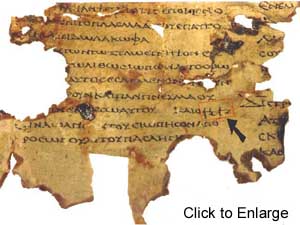
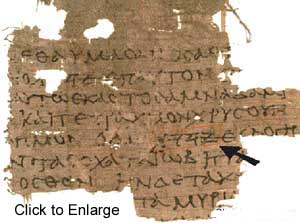
...No wonder, then, that the Greek translators of the Bible, even though some
scribe might now and then write the Tetragrammaton in the archaic Hebrew form on
the margin, II I II I, as found by Origen (see facsimile attached to article
AQUILA), took great care to render the name II I II I regularly Kupios, Lord, as
if they knew of no other reading but Adonai. Translations dependant upon the
Septuagint have the same reading of the Name.
You have just read proof after proof that the words Adonai and Elohim have come
to be substituted for the Name Yahweh, whether in speech or in writing,
throughout The Holy Scriptures so that Yahweh's Name is forgotten. However, the
simple fact remains, in the very earliest writings, known as the J or Yahwist
manuscripts, the Name of Yahweh is used exclusively. So then, how did these
words come to be accepted as suitable substitutes for the Name Yahweh?
Fragments from the Septuagint showing YAHWEH's Name
(The Septuagint is written in Greek, but YAHWEH's Name is written in the ancient
Hebrew)
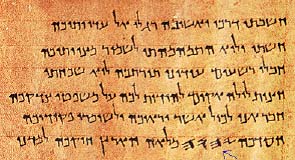
Yahweh's Name In The Dead Sea Scrolls
The following is a photo of Psalms 119:59-64 in the Dead Sea Scrolls which
are a collection of Hebrew Scriptures that date back 2000 years. Note Yahweh's
name in the ancient Hebrew script while the rest of the text is in a more modern
Hebrew that was used at the time.
The Four Main Manuscripts
The general consensus among scholars is that there are four main sources or
manuscripts of The Holy Scriptures named J, E, P, and D. The Encyclopedia
Judaica, Volume 13, page 234, gives us this fact.
Sources. The opinion accepted in contemporary biblical research is that the
pentateuchal literature is composed of four major sources: J, E, P, and D.
This information concerning the major sources of the Scriptures is also shown to
us in The Encyclopedia Brittanica, Volume 2, page 194:
BIBLICAL SOURCE, any of the original documents that, in compilation, constitute
the Bible. Most of the writings in the Old Testament are of anonymous
authorship, and in many cases it is not known whether they were compiled by
individuals or by groups. Nevertheless, by careful evaluation of internal
evidence and with the aid of various schools of biblical criticism (q.v.),
scholars have been able to identify certain sources and to arrange them
chronologically in order of composition.
The means by which the basic sources of the Pentateuch (first five books of the
Bible) were distinguished and their chronology established provided the first
clear picture of Israel's literary and religious development. The names by which
these sources are now known, in chronological order, are: the Yahwist, or J,
source, so called because it employed as the Lord's name a Hebrew word
transliterated into English as YHWH (called J from the German: JHVH) and spoken
as Yahweh; the Elohist, or E, source, distinguished by its reference to the Lord
as Elohim; the Deuteronomist, or D, source, marked by distinctive vocabulary and
style; and the Priestly code, or P, source, which contains detailed ritual
instructions.
Our main concern will focus on the J and E sources. It is very important to note
that the oldest source, the J exclusively. Yes, in the oldest manuscript of the
Scriptures, Yahweh is never referred to by the titles El, Elohim, or Adonai—but
only by His Name, Yahweh! (Yahwist) source, used the Name of Yahweh
The Encyclopedia Judaica, Volume 13, page 234, gives us these facts:
...The distinction between J and E is based primarily on the different usage of
the divine name in these sources: YHWH in J and Elohim ("God") in E. P is the
Priestly Source and D the Deuteronomic. The different usage of the divine name
is not only a matter of form but relates to the type of attitude taken to the
history of the religion of Israel. According to J, YHWH, the Lord of Israel, was
worshipped as early as the time of Enosh (Gen. 4:26), while according to E, YHWH,
i.e., the true name of the God of Israel, was first revealed to Moses at the
burning bush (Ex. 3:6ff.).
...J notes a religious continuity beginning with the time of Enosh and
continuing through the period of the Patriarchs to Moses. In contrast, E and P,
while admitting that the God who was revealed to the Patriarchs is the God who
was revealed to Moses, maintain that the Patriarchs did not know Him by His true
name, and there is doubtless theological significances to this lack of
knowledge. Furthermore, P, which places great emphasis on the religious chasm
between the period of the Patriarchs and that of Moses, does not consider the
possibility of legitimate worship of God (sacrifices) before the revelation in
the time of Moses.
J and E Sources. This difference between J and E is most evident in Genesis,
where it is based on an explicit criterion: YHWH in J as opposed to Elohim in
E...
The J (Yahwist) Source
The Jewish Encyclopedia, Volume 7, pages 64-65, tells us also that the J
manuscript preferred the Name of Yahweh over Elohim:
...(usually symbolized as J): The name given in modern Bible criticism to the
supposed author of those portions of the Pentateuch (or of the Hexateuch) in
which the name yhwh is used for God in preference to the name "Elohim," which
latter is employed by the Elohistic writers.
..it is natural to suppose that J was written as its counterpart, and as an
expression of the view that YHWH ruled all things from the beginning, and that
the faith and worship cherished in Jerusalem were also those of the Fathers.
The Interpreter's Dictionary of the Bible, Volume 2, page 777, tells us this
about the oldest source of The Holy Scriptures, the Yahwist source:
J. One of principal narrative sources or strata of the Pentateuch. The symbol is
derived from the personal name of God, Jehovah (or more accurately Yahweh, from
, the use of which is characteristic of this source. It is commonly regarded as
Judahite in origin, and somewhat earlier than E (tenth-ninth centuries b.c.).
The Anchor Bible, Genesis, Volume 1, pages 37-38, confirms that the J source is
the oldest (and therefore the first and inspired) source of the Scriptures:
...J traced back the name Yahweh to the dim past, while E and P attributed the
usage to Moses, both views may be justified depending on the point vantage. The
worship of Yahweh was in all likelihood confined at first to a small body of
searchers under the aegis of the patriarchs; it was this movement that found a
worthy recorder in J. When Moses set out to fashion a nation out of an amorphous
conglomerate of sundry ethnic and tribal elements, he had to concentrate on
three major features of nationhood: a territorial base, a body of laws, and a
distinctive religion. The last was normative in more ways than one; it was
necessarily the faith of the same forefathers who had already tied it to the
Promised Land, with Yahweh as its fountainhead. To that extent, therefore,
Yahweh revealed himself to Moses: and it is this personal revelation that both E
and P celebrate. To J, however, who chronicled the progress within the inner
circle of the patriarchal pioneers, the personal participation of Yahweh had
been the dominant fact from the start.
The Encyclopedia Judaica, Volume 7, pages 680-681, concerning this "J" writer,
says:
According to the documentary hypothesis, the literary sources in the Pentateuch
known as the Elohist and the Priestly Document never use the name Yahweh for God
until it is revealed to Moses (Ex. 3:13; 6:2-3); but the Yahwist source uses it
from Genesis 2:4 on, thus implying that it was at least as old as Abraham. If
the name is really so old, then Exodus 6:2-3 must be understood as meaning that
from the time of Moses on, Yahweh was to be the personal name of the God who
brought the people of Israel into existence by bringing them out of Egypt and
established them as a nation by His covenant with them at Sinai.
One must wonder, if Abraham and Mosheh had followed the same teaching we today
have known from birth, the Name of our Heavenly Father would have never been
known to us today. It is my opinion that we should praise Yahweh for giving
Abraham and Mosheh the great wisdom to call upon, and write for us, His Name.
The Interpreters Dictionary of the Bible, Volume 2, page 409, confirms the fact
that the earliest manuscripts used only the Name Yahweh.
...The Yahwist narrative (see Pentateuch) traces the worship of Yahweh far back
beyond the period of Moses and affirms that in the time of Enosh, the grandson
of Adam, men first began to invoke the name of Yahweh (Gen. 4:26). This
narrator's consistent use of the name from the story of Creation onward
represents a theological attempt to view the whole of human history in the light
of the covenant faith and to demonstrate that Yahweh is not just the God of
Israel but of all mankind (Enosh means "man")...
...Although the name was given new currency in Mosaic circles, the J account
(Gen. 4:26) may preserve a dim recollection that it was known in the pre-Mosaic
period....
...However, the latest Pentateuchal tradition, the priestly writing (P), gives a
completely different view in Exod. This conjecture is confirmed by a third
Pentateuchal tradition, E, which avoids using Yahweh in the book of Genesis...
...In the earliest Hebrew the sacred name appeared as a four-letter word or
tetragrammaton: YHWH - without any vowel signs...
Knowing the time in which the blinded scribes began to replace Yahweh's Name
with titles of gods and Lords, and then reading the rebuke given to them by the
Prophet Yeremyah (Chapter 23) for making Yahweh's people forget His great Name,
we see the pieces of an historical puzzle start falling into place. After
rejecting and hiding Yahweh's Name, it's obvious that the next step was to
reject and deny Yahweh's great laws.
The translation of the Holy Scriptures from Hebrew to Aramaic, the Targums, are
known for their literal adherence to the original Hebrew Scriptures which used
the Name Yahweh. The Chumash with Targum Onkelos and Rashi's Commentary, shows
us that in Genesis 1:1, where Elohim is used in the Masoretic text, the Targum
Onkelos uses the Aramaic abbreviation for Yahweh.
Masoretic Text: The word ELOHIM is circled

Targum Onkelos: The Name YAHWEH is circled

The E (Elohist) Source
The E or Elohist source is derived from the word elohim, god, the use of which
is characteristic of this source. Please remember, the J (Yahwist) source is the
oldest source, meaning the Elohist source came after the Yahwist source. The
Interpreters Dictionary of the Bible, Volume 2, page 1, tells us:
E (ELOHIST) -. One of the principal narrative sources or strata of the
Pentateuch. The term is derived from a Hebrew word for "God" (, Elohim; see GOD,
NAMES of, § 3c), the use of which is characteristic of this source.
The Jewish Encyclopedia, Volume 5, page 142, confirms that the E source used
Elohim in place of Yahweh's Name.
...The use of "Elohim" for "God" is the most notable characteristic of E. ...the
symbol J (=Jahvist) applying to passages in which the name "YHWH" is
predominant. "Adonai" and "El" occur occasionally (Gen. xx. 4, xxx. 20, xxxv. 7,
xliii. 14).
The Interpreter's Dictionary, Volume 2, page 94, also shows that this source is
commonly associated with the Northern Kingdom of Israyl, and dates approximately
100 years later than the Yahwist source.
ELOHIST, The author or compiler of the E source of the Pentateuch (see E), which
is commonly associated with the N kingdom and dated to the eighth century b.c.
The Anchor Bible, Proverbs-Ecclesiastes, Volume 18, page xxxi, tells us that the
Elohist (E) source shows its ORIGIN to be in the NORTHERN KINGDOM of Israyl,
when the kingdom split in two AFTER the death of Solomon:
The fact that the E document in the Pentateuch shows evidences of origin in
North Israel after the division of the kingdom at Solomon's death, but follows
the outline of the Judean J document which it later was used to supplement,
indicates that both stem from a common source before the kingdom split in two.
Do you grasp the significance of this? This says that both the Yahwist and the
Elohist sources stem from a common source before the kingdom split in two. This
actually means they used the same work, however, while one retained Yahweh's
Name in the Holy Scriptures, the other replaced Yahweh's Name with the title
Elohim.
The Universal Jewish Encyclopedia, Volume 9, page 160, gives us more proof that
Yahweh's Name appeared in the original writings, and Adonai and Elohim were
added later.
Of the names of God in the Old Testament, that which occurs most frequently
(6,823 times) is the so-called Tetragrammaton, YHWH (), the distinctive personal
name of the God of Israel. This name is commonly represented in modern
translations by the form "Jehovah," which, however, is a philological
impossibility (see Jehovah). This form has arisen through attempting to
pronounce the consonants of the name with the vowels of Adonai (="Lord"), which
the Masorites have inserted in the text, indicating thereby that Adonai was to
be read (as a "keri perpetuum") instead of YHWH. When the name Adonai itself
precedes, to avoid repetition of this name, YHWH is written by the Masorites
with the vowels of Elohim, in which case Elohim is read instead of YHWH. In
consequence of this Masoretic reading the authorized and revised English
versions (though not the American edition of the revised version) render yhwh by
the word "Lord" in the great majority of cases.
This name, according to the narrative in Ex. iii. (E), was made known to Moses
in a vision at Horeb. In another, parallel narrative (Ex. vi. 2, 3, P) it is
stated that the name was not known to the Patriarchs. It is used by one of the
documentary sources of Genesis (J), but scarcely if at all by the others. Its
use is avoided by some later writers also. It does not occur in Ecclesiastes,
and in Daniel is found only in ch. ix. The writer of Chronicles shows a
preference for the form Elohim, and in Ps. xliii.-lxxxiii. Elohim occurs much
more frequently than YHWH, probably having been substitued in some places for
the latter name , as in Ps. liii. (comp. Ps. xiv.).
The Ancient And Honored Name Of Yahweh
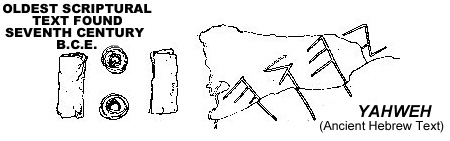
 The
very oldest Scriptural text ever found, dating back almost 2,600 years, was
found in a tiny silver amulet which contains a Seventh Century b.c.e. extract
from the Book of Numbers (6:24-26), the priestly blessing. The rolled up amulet
was part of a treasure hard found by a Tel Aviv University archeologist in a
First Temple Period family tomb in Yerusalem, Israyl. When this amulet was
written, the Temple of Solomon still stood, the heirs of King David still ruled
on the throne, and the Dead Sea Scrolls would not be written for another 400
years.
The
very oldest Scriptural text ever found, dating back almost 2,600 years, was
found in a tiny silver amulet which contains a Seventh Century b.c.e. extract
from the Book of Numbers (6:24-26), the priestly blessing. The rolled up amulet
was part of a treasure hard found by a Tel Aviv University archeologist in a
First Temple Period family tomb in Yerusalem, Israyl. When this amulet was
written, the Temple of Solomon still stood, the heirs of King David still ruled
on the throne, and the Dead Sea Scrolls would not be written for another 400
years.
It was three years after its discovery before this fragile amulet could be
unrolled by technical experts at the Israyli Museum. On this amulet the Name of
Yahweh could be clearly read. Complete details of this magnificent find can be
read in the 6-28-86 and 8-9-86 issues of The Jerusalem Post and the 6-87 issue
of The Readers Digest.
The following excerpt was taken from an article in the November/December 1997
issue of Biblical Archaeology Review, pages 28-32. We see here that the
Creator's work during the time of Solomon was known by the same Name as it is
today—The House of Yahweh. It was Solomon who built the Temple where this tithe
was given. You can read of this in I Kings 6.
Three Shekels For The Lord
Ancient Inscription Records Gift To Solomon's Temple
Two extremely important Hebrew inscriptions have recently surfaced on the
antiquities market. One appears to be a receipt for a donation of three silver
shekels to the House of Yahweh, pursuant to an order of the Israelite king. This
is the oldest extra-Biblical mention of King Solomon's Temple ever discovered.
The other inscription records the petition of a widow for some portion of her
late husband's property. Both inscriptions, apparently by the same scribe, are
written in Old Hebrew, or paleo-Hebrew, the script used before the Babylonian
Exile. Both are on pieces of pottery, called ostraca because they bear an
inscription.
Only one other extra-Biblical source mentions Solomon's Temple, destroyed by the
Babylonians in 586 B.C.E...
The text on the first ostracon, which measures about 4 inches wide by 3.5 inches
tall (10.9 by 8.6 cm), is only 5 lines and 13 words long. All the words are
complete and readable. See the box for the text and translation.
A TEMPLE RECEIPT
Text:
1. K'SR SWK. 'SY
2. HW.HMLK.LTT.BYD
3. [Z]KRYHW.KSP TR
4. SS.LBYT YHWH [.]
5. S3
Translation:
1. Pursuant to the order to you of Ashya-
2. hu the king to give by the hand
3. of [Z]echaryahu silver of Tar-
4. shish to the House of Yahweh
5. Three shekels.
*Brackets indicate that the letter or word has been reconstructed. Half-brackets
indicate that part of the leter or word has been reconstructed.
Most of the words are separated from one another by dots acting as word
dividers. However, sometimes the word dividers are omitted, such as between LBYT
and YHWH, which together are pronounced Beit Yahweh and mean "House of Yahweh."
The Temple is designated by the Hebrew term BYT YHWH, many times in the Bible.
(Temple only refers to the building, Beit—House refers also the people of
Yahweh). But BYT YHWH had been found complete in only one extra-Biblical
inscription, a faded ostracon from Arad with an obscure context, until this
newly published ostracon was revealed.
BYT YHWH has been reconstructed on the inscribed ivory pomegranate that served
as the head of a priestly scepter in Solomon's Temple... divine name would mean
"he causes to be, or exist," i.e., "he creates." Amorite personal names after
2,000 B.C. lend support to the Haupt-Albright view, demonstrating that the
employment of the causative stem yahwe "he creates" was in vogue in the
linguistic background of early Hebrew.
The Interpreter's Dictionary of the Bible, Volume 4 page 923 says:
YAHWEH—The vocalization of the four consonants of the Israylite name for the
Creator, which scholars believe to approximate the original pronunciation.
The Wycliffe Bible Encyclopedia, page 690 tells us:
The Name par excellence for the Creator of Israyl is Yahweh, found 6,823 times
in the OT. Through Israyl's deliverance from bondage in Egypt, adoption as a
nation, and guidance to the Promised Land, the Redeemer-Creator is especially
known by THIS NAME. (Emphasis ours).
James Moffatt, in his translation, The Bible: A New Translation, 1935, Harper
and Brothers, informs us in his introduction:
Strictly speaking this ought to be rendered Yahweh which is familiar to modern
readers in the erroneous form of Jehovah. Were this version intended for
students of the original, there would be no hesitation whatever in printing
Yahweh.
Although Moffatt substitutes the title, The Eternal in the place of the Name of
Yahweh, he fully admits a distinct loss of meaning in this.
The Encyclopedia Judaica, Volume 7, page 680 states emphatically:
The true pronunciation of the Name YHWH was never lost. Several early Greek
writers of the Christian Church testify that the Name was pronounced Yahweh.
The Hebrew-Aramaic-English Dictionary, by Marcus Jastrow, Volume 1, page 576,
proves that the abbreviation in the Targum Onkelos is that of Yahweh's Name
 m. (abbrev. of the
Tetragrammaton) Targ. Ps. 1, 2 (ed. Lag.
m. (abbrev. of the
Tetragrammaton) Targ. Ps. 1, 2 (ed. Lag.
 ); a. fr.__Y. Snh.
X, 28a top; a. fr. (interch. in eds. with
); a. fr.__Y. Snh.
X, 28a top; a. fr. (interch. in eds. with ).
).
The book The Meaning of the Qumran Scrolls for the Bible page 164 tells us that
in these original writings the Name Yahweh stood alone.
Actually this practice was much earlier, for one of the frequent discrepancies
between the Massoretic text and the presumed Hebrew Vorlage of the Septuagint is
whether to read in a given passage Yahweh alone, or Yahweh Adonai. This
inconsistency was occasioned by the fact that originally Yahweh did stand alone,
but that Adonai tended to be introduced alongside the Tetragrammaton by way of
making explicit the surrogate. This was not understood by the Massoretes,
however, who felt compelled to vocalize both words. Neither was it understood by
the scribes of the Qumran Scrolls, nor even by still earlier translators of the
LXX. That Yahweh originally stood alone in most passages is supported by the
fact that, in Hebrew poetry, the double designation of the Deity usually adds
excessive length to the poetic stich.
So not only do we have proof that the Name Yahweh was written in the original
Holy Scriptures, we have proof that it was spoken by all of Yahweh's people as
well.
Yahweh's Name is written yod-heh-waw-heh in Hebrew, transliterated YHWH in
English, but was written and properly pronounced, YAHWEH as these sources show.
Notice what The Jewish Encyclopedia, Volume 12, page 119 states:
It thus becomes possible to determine with a fair degree of certainty the
historical pronunciation of the tetragrammaton, the results agreeing with the
statement of Ex. iii. 14, in which YHWH terms Himself . "I will be," a phrase
which is immediately proceeded by the fuller term "I will be that I will be,"
or, as in the English versions, "I am" and "I am that I am." The name is
accordingly derived from the root =() and is regarded as an imperfect. This
passage is decisive for the pronunciation "Yahweh"; for the etymology was
undoubtedly based on the known word.
The personal Name of the Father of Israyl is written in the Hebrew Scriptures
with the four consonants YHWH, and is referred to as the Tetragrammaton. At
least until the destruction of the First Temple 586 B.C.E., Yahweh's Name was
pronounced regularly with its proper vowels, as is clear from the Lachish
Letters, written shortly before that day. However, at least by the third century
before our Messiah was born, the pronunciation of the Name Yahweh was avoided,
and Adonai, the Lord, was substituted for it.
The Century Bible, Volume 1, pages 90-91 tells us:
Some time after the return from the Captivity, and before the beginning of the
Christian Era, the Yahdaim (Jews) came to believe that the Holy Name YAHWEH was
too sacred to be uttered on ordinary occasions. It was said to be pronounced by
the High Priest on the Day of Atonement. At other times, when any one read or
quoted aloud from what is called the Old Testament, the word Adonay, Lord, was
usually substituted for Yahweh, and similarly the LXX (Septuagint Version) has
Kurios, the Vulgate dominus, and the E.V. Lord, where the Hebrew has Yahweh.
Hebrew was originally written without vowels, but when the vowel points were
added, the vowels of Adonay or Elohim were written with Yahweh, as a direction
that these words were to be read instead of the word whose consonants were
Yahweh; thus we find the combinations YeHoWah and YeHoWiH. At the Reformation,
the former being the more usual, was sometimes used as the Name of the (Mighty
One) Of Israyl, and owing to ignorance of its history was misread as Jehovah, a
form which has established itself in English, but does not give the
pronunciation of the Holy Name it represents.
Three-shekel receipt provides evidence of King Solomon's Temple
NEW YORK (AP)- Talk about holding on to a receipt.
A recently discovered piece of pottery recording a donation to the "House of
Yahweh" may contain the oldest mention outside the Bible of King Solomon's
Temple.
The 3-1/2 by 4-inch artifact is nearly 3,000 years old, dating to a time when
kings sent messenges inscribed on pottery. - 11/3/97
(AP Photo)
